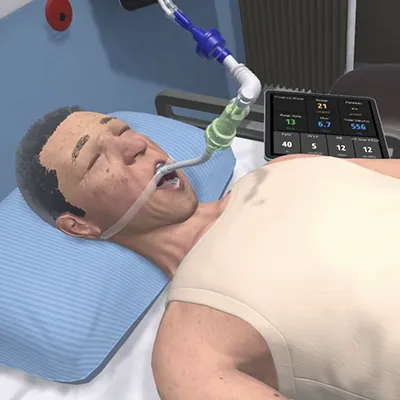
Virtual Patient Simulation with Real-Time Physiology
Body Interact is a virtual patient simulation platform built on a real-time physiological engine, meaning every decision, delay, and error dynamically changes the patient’s condition as it would in real clinical practice.
Vital signs shift. Organ systems compensate or deteriorate. Symptoms evolve. Treatment may stabilize or worsen the situation.
At the core of every scenario is a physiological simulation engine that drives patient evolution, making the experience far closer to real clinical practice than scripted simulations with fixed decision trees.
Why a Physiological Engine is Central to Clinical Simulation Training
Students may understand disease mechanisms in theory, but connecting that knowledge to a live patient encounter is where clinical education often falls short.
“Why does oxygen saturation fall?”
“Why does blood pressure deteriorate?”
“Why does one intervention improve the patient while another causes harm?”
These cause-and-effect relationships are not always intuitive. Body Interact’s virtual patient simulation makes them visible.
Every action taken during the scenario affects the patient through an underlying physiological model. Appropriate treatment can stabilize the patient. Delayed intervention can worsen the condition. Incorrect management can trigger deterioration, complications, or, in more advanced scenarios, even cardiac arrest.
This allows learners to follow the consequences of their decisions in a way that reflects real clinical care. The patient’s evolution is tied to the clinical situation and to the actions taken during the scenario.
How the Physiological Simulation Engine Works
Body Interact’s physiological engine spans 50+ therapeutic areas and drives several interconnected models:
- 🫁 Respiratory physiology: an advanced ventilatory algorithm that seamlessly connects spontaneous breathing, mechanical ventilation, and arterial blood gas physiology.
- 💊 Pharmacological modeling: 600+ medications can produce realistic therapeutic and adverse effects across organ systems. Appropriate administration can stabilize the patient, while mismanagement may lead to deterioration or even cardiopulmonary arrest.
- 🩺 Acute care deterioration: Scenarios reflect deterioration, escalation, and recovery according to the clinical decisions made during the simulation.
This creates a learning environment in which patient responses are not reduced to isolated events. Students can observe the real physiological consequences of care.
Curious to see our physiology model in action?
Examples Across Body Interact scenarios
🧠 Adverse drug effects in stroke management
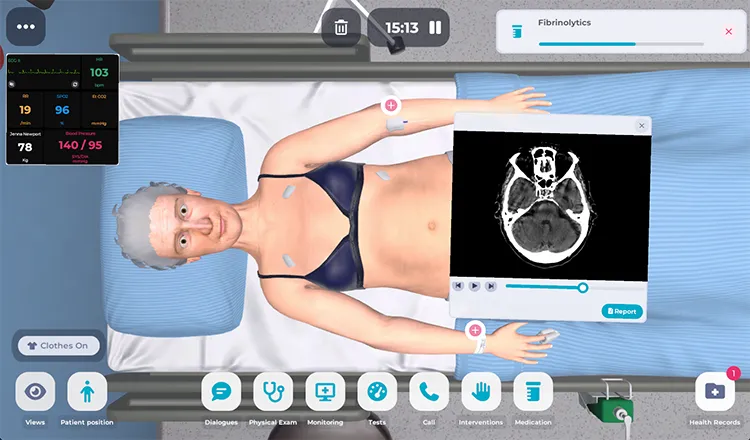
In Body Interact’s virtual patient simulation, incorrect medication administration leads to clinically accurate physiological consequences.
For example, in stroke scenarios, fibrinolytic overdose or administration during severe hypertension can result in hemorrhagic transformation, reflecting complications described in stroke management guidelines from the American Stroke Association, a division of the American Heart Association.
This helps learners understand that treatment choices carry physiological risk and that those risks must be recognised before action is taken.
🩻 Advanced ventilatory algorithm with integrated ABG physiology
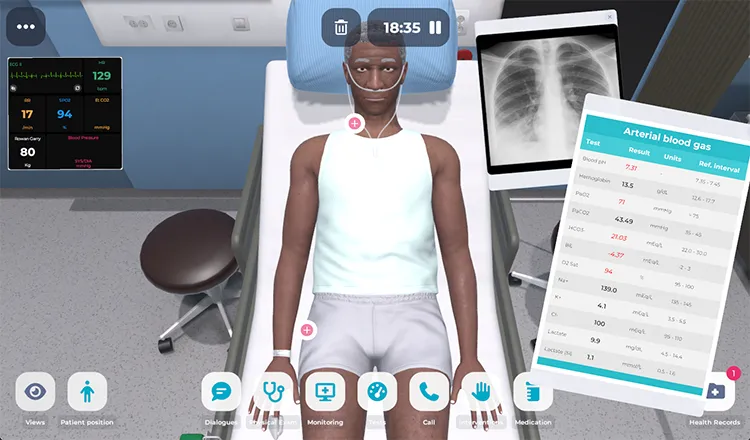
Across Body Interact’s scenarios, from basic to advanced, the patient’s condition evolves in real time according to oxygenation, ventilation, and gas exchange.
The ventilatory algorithm seamlessly connects spontaneous breathing, mechanical ventilation, and arterial blood gas physiology into a single dynamic model. Adjustments are made continuously as the simulation unfolds, generating realistic respiratory responses at any stage of the scenario.
The respiratory algorithm design is aligned with the European Association of Cardiothoracic Anaesthesiology and Intensive Care (EACTA) guidelines.
🩸Transfusion incompatibility and patient safety
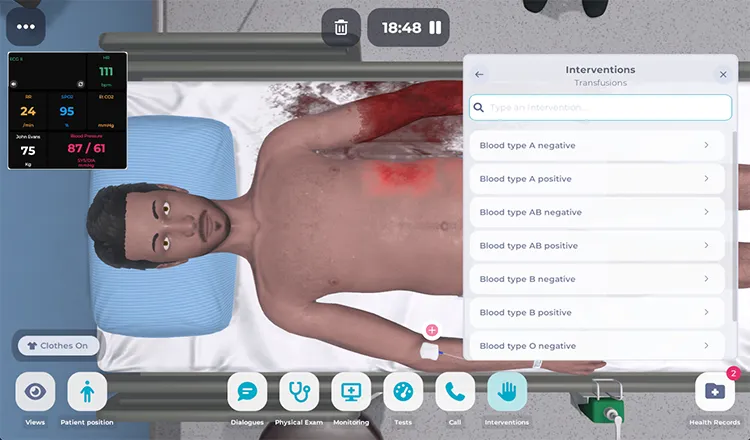
In transfusion scenarios, incompatible blood administration triggers a visible physiological reaction in the virtual patient.
Rather than receiving only retrospective feedback, students can watch the patient deteriorate in real time as a direct consequence of the error.
Body Interact realistically simulates adverse reactions to incompatible blood transfusions, with the underlying transfusion physiology model developed in collaboration with the American Blood Centers.
🫀 Dynamic cardiac arrest and resuscitation
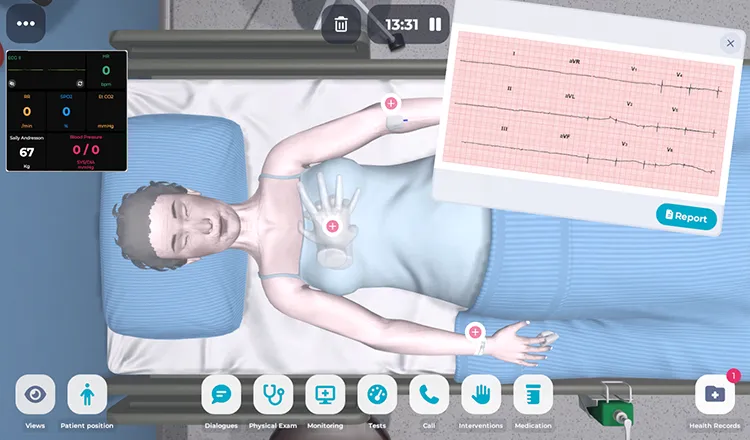
It’s critical to understand the body’s response to trauma, shock, and acute illness for effective emergency care. Cardiac arrest can emerge from untreated physiological instability.
Body Interact’s virtual patients reflect this through dynamic cardiac arrest modeling. Patients may deteriorate and progress toward cardiac arrest due to multiple physiological causes if underlying conditions are not addressed.
Effective interventions can lead to successful resuscitation, per European Resuscitation Council (ERC) and American Heart Association (AHA) guidelines, with vital signs adjusting to realistic post-resuscitation values.
A globally trusted, clinically validated medical simulation platform
For more than 18 years, Body Interact has worked closely with over 40 internationally recognized medical societies and organizations, including the American Heart Association, American Stroke Association, Pan-American Trauma Society, Angels Initiative, and the European Society of Cardiology, as well as with hundreds of clinical reviewers worldwide.
All therapeutic and adverse effects in Body Interact are grounded in established clinical literature and aligned with evidence-based medical practice.
By Ana Santa – MSN, APRN
Editorial Manager