Body Interact and Preparation for High-Stakes Clinical Examinations
Exams such as the NBME, USMLE, NCLEX, PANCE/PANRE, commonly known as high-stakes examinations, have a crucial role in the progression, certification, and licensure of future healthcare professionals. These are summative, decision-making exams that use standardized vignette-based multiple-choice items to assess clinical reasoning and applied knowledge rather than factual recall alone.
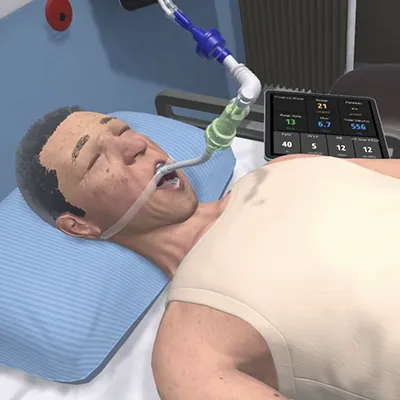
Body Interact is a virtual patient simulation designed to teach and prepare students for these demands by immersing them in realistic, time‑pressured clinical scenarios. Grounded in established educational theory, such as Miller’s Pyramid of Clinical Competence, and supported by evidence from simulation‑based clinical education research, Body Interact strengthens clinical reasoning, knowledge transfer, and exam‑relevant performance. As a result, it offers institutions a scalable, standardized, and pedagogically robust solution for high‑stakes exam preparation.
What Are High‑Stakes Examinations?
High‑stakes examinations are assessments whose outcomes have significant consequences for students, including advancement in training, graduation, certification, or licensure. In health professions education, these exams typically evaluate:
- Cognitive knowledge
- Clinical reasoning and decision‑making
- Application of knowledge to patient care
- Professionalism and prioritization under time constraints
Because these exams simulate real clinical demands, preparation strategies must go beyond memorization and emphasize applied, contextual learning.
Theoretical Foundation: Miller’s Pyramid of Clinical Competence
Miller’s Pyramid of Clinical Competence provides a widely accepted framework for understanding assessment in medical education. It describes four progressive levels of competence:
- Knows – factual knowledge
- Knows How – application of knowledge
- Shows How – demonstration of skills in simulated settings
- Does – performance in real clinical practice
Modern high‑stakes examinations commonly target the upper levels of this pyramid, particularly Knows How and Shows How. OSCEs explicitly assess performance at the Shows How level, while contemporary written exams emphasize clinical vignettes requiring reasoning rather than recall.
Body Interact directly supports these higher levels by enabling students to actively manage virtual patients, make diagnostic and therapeutic decisions, and experience the consequences of those decisions in a controlled and safe environment.
How Does Body Interact Support Exam Readiness?
Clinical Reasoning Application
Students using Body Interact must collect and resume patient data, prioritize problems, define diagnostic hypotheses, and define and adjust management strategies dynamically. This mirrors the reasoning processes assessed in both OSCEs and case‑based written examinations.
Performance Under Pressure
High‑stakes exams are characterized by time constraints, uncertainty, stress and cognitive load. Body Interact recreates these conditions while maintaining psychological safety, helping students build confidence and reduce anxiety during real examinations.
Evidence‑Based Learning
Research in health professions education demonstrates that active, simulation‑based learning improves knowledge retention, clinical reasoning, and transfer to assessment and practice. Body Interact incorporates these principles through interactive decision‑making and structured feedback, supporting deliberate practice and self‑regulated learning.
Standardization and Scalability
Body Interact delivers consistent clinical experiences across students, enabling institutions to align exam preparation with curricular outcomes while maintaining fairness and comparability.
Preparing for Written and Performance‑Based Assessments
By strengthening the connection between foundational knowledge and its clinical application, Body Interact prepares students for both performance‑based exams (such as OSCEs) and applied knowledge exams (like NBME‑style assessments).
Learn how Body Interact supports OSCE implementation and assessment – download guide here
Academic and Institutional Value
Body Interact aligns with competency‑based education models and current accreditation standards, simultaneously offering institutions a way to measure exam readiness, students’ confidence, and clinical preparedness.
Effective preparation for high‑stakes examinations requires more than memorization – it requires repeated, contextualized application of knowledge and clinical reasoning under realistic conditions. Supported by educational theory and a robust evidence base for simulation‑based learning, Body Interact provides a comprehensive solution for preparing students to succeed in OSCEs, NBME‑style exams, and national licensing examinations.
References
1. Bray, K., Bray, L., Sathyapalan, T., Rigby, A. S. & Hepburn, D. A pilot study comparing immersive virtual reality simulation and computerized virtual patient simulation in undergraduate medical education. International Journal of Healthcare Simulation (2023) doi:10.54531/rxca9513.
2. Cook DA, Hatala R, Brydges R, Zendejas B, Szostek JH, Wang AT, Erwin PJ, Hamstra SJ. Technology-enhanced simulation for health professions education: a systematic review and meta-analysis. JAMA. 2011 Sep 7;306(9):978-88. doi: 10.1001/jama.2011.1234. PMID: 21900138.
3. Gonullu I, Bayazit A, Erden S. Exploring medical students’ perceptions of individual and group-based clinical reasoning with virtual patients: a qualitative study. BMC Med Educ. 2024 Feb 25;24(1):189. doi: 10.1186/s12909-024-05121-x. PMID: 38403641; PMCID: PMC10895817.
4. Issenberg SB, McGaghie WC, Petrusa ER, Lee Gordon D, Scalese RJ. Features and uses of high-fidelity medical simulations that lead to effective learning: a BEME systematic review. Med Teach. 2005 Jan;27(1):10-28. doi: 10.1080/01421590500046924. PMID: 16147767.
5. McGaghie WC, Issenberg SB, Petrusa ER, Scalese RJ. A critical review of simulation-based medical education research: 2003-2009. Med Educ. 2010 Jan;44(1):50-63. doi: 10.1111/j.1365-2923.2009.03547.x. PMID: 20078756.
6. Miller GE. The assessment of clinical skills/competence/performance. Acad Med. 1990 Sep;65(9 Suppl):S63-7. doi: 10.1097/00001888-199009000-00045. PMID: 2400509.
7. Padilha JM, Machado PP, Ribeiro A, Ramos J, Costa P. Clinical Virtual Simulation in Nursing Education: Randomized Controlled Trial. J Med Internet Res. 2019 Mar 18;21(3):e11529. doi: 10.2196/11529. Erratum in: J Med Internet Res. 2019 Jun 27;21(6):e14155. doi: 10.2196/14155. PMID: 30882355; PMCID: PMC6447149.