AI-Driven Conversations
Natural Patient Communication in Body Interact
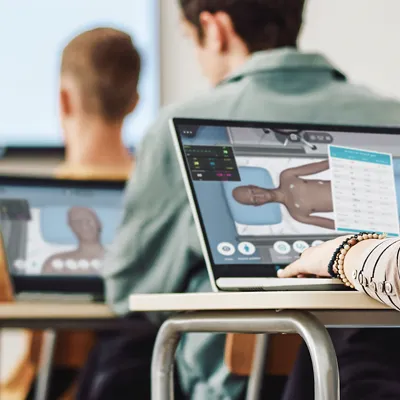
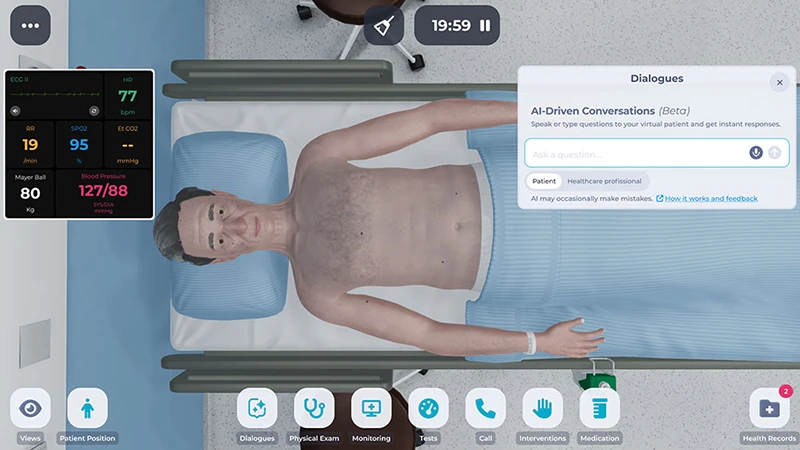
Body Interact now fully supports open-ended, AI-driven patient communication. A major advancement that brings natural, human-like patient communication into the simulation experience.
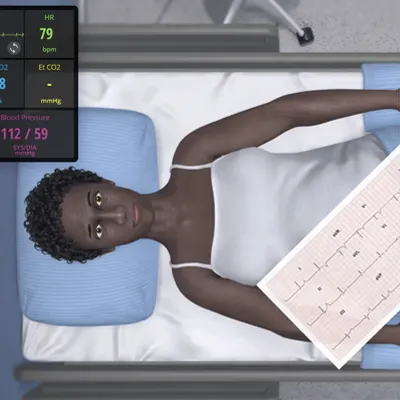
Using voice recognition or text input, students can now speak or type freely, exactly as they would in a real clinical encounter. The virtual patient’s responses adapt dynamically to both the conversation and the scenario’s evolving physiology.
Why Natural Communication Matters in Healthcare Education
Many healthcare educators are concerned that students are entering the workforce with less confidence in spontaneous, professional communication. In real clinical encounters, communication is clinical care.
History-taking, rapport building, explanation, clarification, and closure all shape the quality of the encounter. They influence what information is gathered, how quickly concerns are recognized, and how safely decisions are made.
Communication Assessment Grounded in Established Frameworks
The new Communication Assessment in Body Interact is structured around the frameworks most widely used in healthcare education: the Calgary-Cambridge Guide, the SEGUE Framework, and the Kalamazoo Consensus Statement.
AI-Generated Analysis Domains
An AI-generated analysis evaluates student performance across four domains:
- Initiating the Encounter and Establishing Rapport
- Information Gathering
- Information Giving and Explanations
- Closing the Encounter
Each domain surfaces specific communication behaviors. Not just whether the student asked the right questions, but how they asked them and how they responded to what the patient said.
In EMS scenarios, Body Interact evaluates coverage of SAMPLE and OPQRST rather than the traditional history-taking structure. This keeps the communication assessment aligned with the protocols EMS providers are expected to follow in practice.
Availability and Technical Requirements
AI-Driven Conversations are available in beta from April 22, 2026, across all Body Interact clinical scenarios on Web, Windows, and Mac.
The update is currently optimized for English and Spanish, supporting more natural interactions across two of the most widely used languages in our Community.
A stable internet access is required. Support for Android, iOS, and additional languages will follow soon.
Check all requirements and usage recommendations
See What This Can Add to Your Program
By combining voice recognition, natural conversation, real-time physiological response, and scenario-specific communication assessment, AI-Driven Conversations adds a powerful new dimension to Body Interact.
See how Body Interact can support your communication training and clinical reasoning development.
By Raquel Bidarra
Chief Experience Officer