Medication Without Harm: Realistic Adverse Drug Effects
Medication administration is one of the most critical responsibilities in healthcare education and clinical practice. Yet, in traditional pharmacology teaching, students often learn medications through memorization, drug names, mechanisms of action, dosages, and side effects, without truly understanding how adverse drug effects manifest in real patients.
This is where immersive simulation becomes transformative.
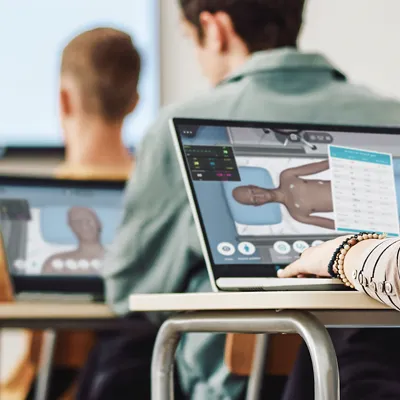
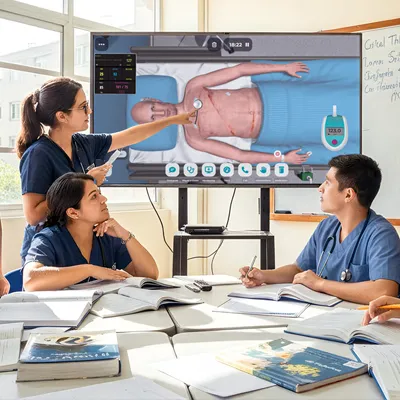
At Body Interact, adverse drug effects are integrated into realistic virtual patient encounters, allowing learners to experience the clinical consequences of pharmacological decisions in a safe and controlled environment.
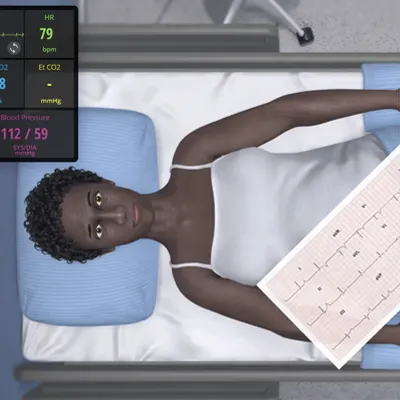
Instead of simply reading that a bronchodilator may cause tachycardia or that opioids can depress respiration, learners must recognize these changes dynamically during patient care. Incorrect medication administration can lead to clinically significant consequences.
Respiratory depression after opioid administration
Tachyarrhythmias associated with bronchodilators
Moving Beyond Memorization
Pharmacology education has traditionally focused on theoretical knowledge acquisition. However, research consistently demonstrates that clinical reasoning and contextual application are essential for medication safety and patient outcomes.
Simulation-based education helps bridge this gap by connecting pharmacological theory with clinical decision-making.
In a realistic simulation environment, adverse drug reactions are not isolated facts; they become evolving clinical situations. Learners must:
- Monitor patient responses,
- Identify early signs of deterioration,
- Prioritize interventions,
- Communicate concerns,
- And reassess outcomes after interventions.
This promotes active learning and deeper cognitive integration.
The Importance of Realistic Adverse Drug Effects
Adverse drug events remain a major challenge in healthcare systems worldwide. According to the World Health Organization (WHO), “unsafe medication practices and medication errors are a leading cause of injury and avoidable harm in health care systems across the world.”
Globally, the cost associated with medication errors has been estimated at $42 billion USD annually. Many of these events are linked to failures in recognition, monitoring, or clinical judgment.
Education and training are a subdomain of the Strategic Framework of the Global Patient Safety Challenge. By exposing learners to realistic adverse effects during training, simulation helps develop essential competencies such as:
- Medication safety,
- Clinical judgment,
- Patient assessment,
- Early recognition of deterioration,
- Interprofessional communication,
- And safe pharmacological reasoning.
For example, a learner administering antihypertensive therapy in a virtual scenario may observe progressive hypotension, dizziness, and altered mental status. Rather than simply recalling a side effect from a textbook, the learner must interpret clinical data, identify the relationship between the medication and symptoms, and take appropriate action.
This experiential learning process strengthens retention and improves preparedness for real-world practice.
Why Fidelity Matters
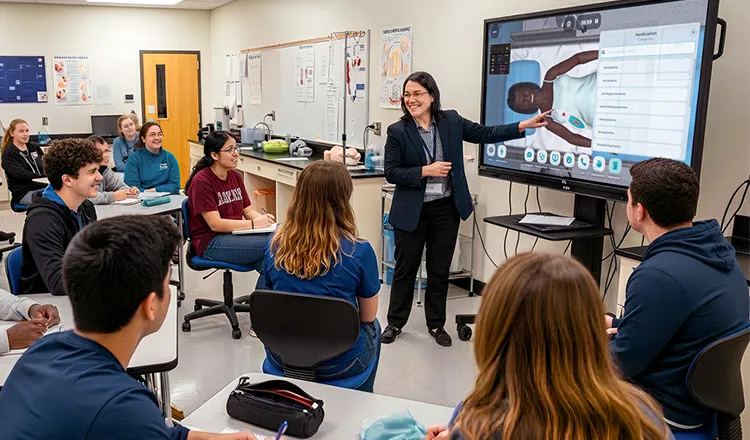
The educational value of simulation increases when patient responses feel authentic and clinically coherent. Research in simulation-based learning highlights that realism, including physiological responses to medications, enhances learner engagement, critical thinking, and transfer of knowledge to clinical settings.
At Body Interact, adverse drug effects evolve according to the learner’s decisions and timing of interventions. This creates a dynamic learning experience where actions have consequences, closely mirroring clinical reality.
Building Safer Healthcare Professionals
One of the greatest advantages of simulation is psychological safety. Learners can make mistakes, recognize consequences, and improve without risking patient harm. This supports reflective learning and confidence development.
Importantly, realistic pharmacology simulation does not only teach “what drug to give.” It teaches:
- when to reassess,
- what complications to anticipate,
- how to identify adverse reactions early,
- and how to respond safely and effectively.
As healthcare becomes increasingly complex, educational strategies must prepare students for real clinical uncertainty, not just ideal textbook scenarios.
By integrating realistic adverse drug effects into virtual patient simulations, Body Interact helps transform pharmacology education into an active, clinically meaningful experience that strengthens decision-making, improves medication safety awareness, and ultimately contributes to better patient care.
Bring High-Fidelity Pharmacology Simulation to Your Program
Speak with one of our educational specialists today to see our real-time physiological engine in action and discover how easily it integrates into your existing curriculum.
References
1. World Health Organization (2026) Medication Without Harm: WHO Global Patient Safety Challenge.
1. Mishra, R., Hemlata, & Trivedi, D. (2023). Simulation-based learning in nursing curriculum- time to prepare quality nurses: A systematic review and meta-analysis. Heliyon, 9(5), e16014. https://doi.org/10.1016/j.heliyon.2023.e16014
By Ana Santa – MSN, APRN
Editorial Manager